
Cherokee County Court Records After Arrest
After a Cherokee County arrest, the jail record and the court record split into different tracks. The jail track starts with transport to the Cherokee County Detention Center, intake, the magistrate stage, dress out, medical screening, and housing. The court track begins when the case is filed, calendared, or otherwise appears in the North Carolina court system. A booking charge may be the first description of the allegation, but prosecutors can amend, reduce, dismiss, supersede, or indict charges as the case develops.
For custody and booking details, use Cherokee County jail inmate records. For booking photos, use the Cherokee County jail mugshots page because court files usually do not publish jail booking photos. Court records after arrest are better for charge status, hearing dates, bond conditions, warrants tied to missed court, and final dispositions.
Find Court Records After Arrest
The official statewide online channel is the North Carolina eCourts Portal. Its landing page exposes Smart Search for court records and case information, Search Hearings for court dates, Make Payments for some criminal or infraction matters, and NC Judgment Search. The portal also shows registration and sign-in options, browser and cookie requirements, and a CAPTCHA notice for anonymous, registered, and elevated users.
- Start with the defendant's full legal name from the jail booking or court notice.
- Use Smart Search for case information and narrow to Cherokee County when the interface allows.
- Use Search Hearings when the immediate need is the next court date rather than the full case history.
- Open each matching case and read the charge list, case number, hearing events, and current status.
- Compare the court charge list with the jail booking charge, because they may not match after review by the District Attorney.
The portal screenshot captured from NC eCourts Portal shows the statewide tools used for court records after a Cherokee County arrest.
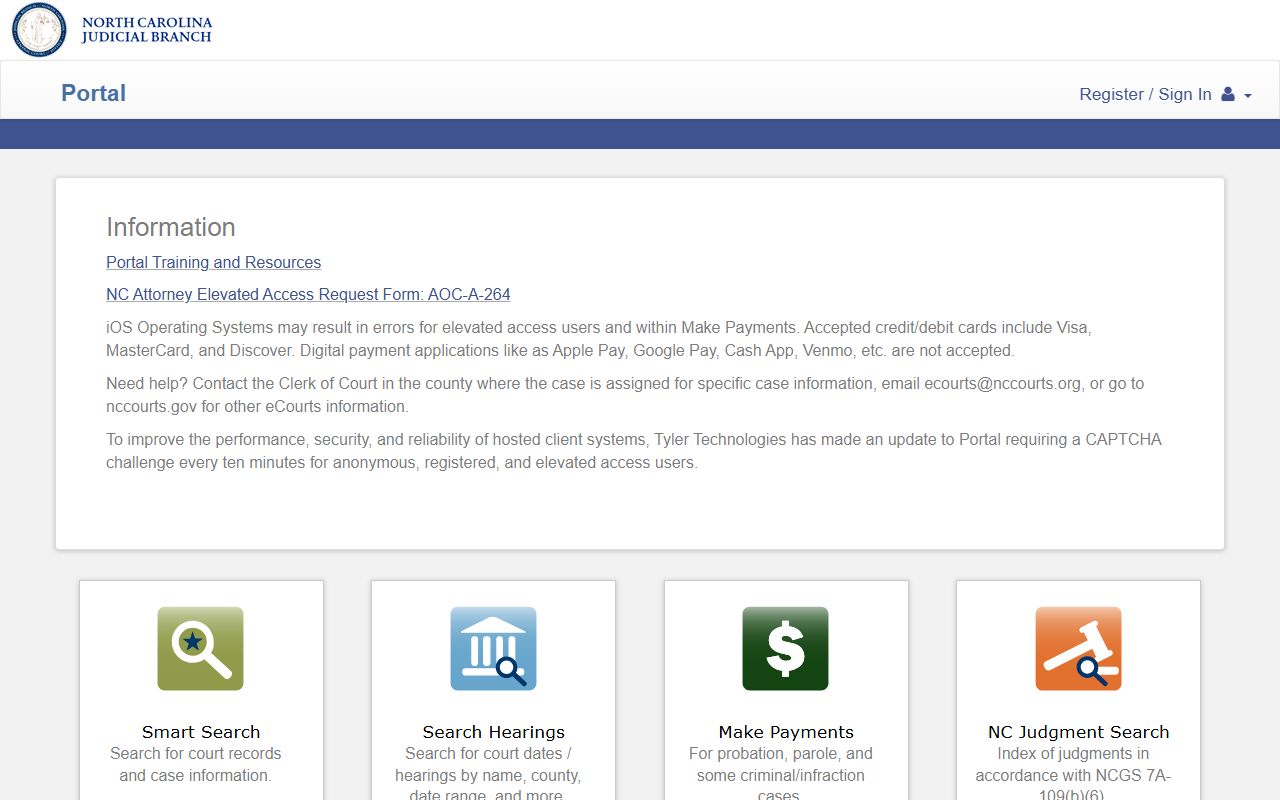
The portal is statewide, so county filters, names, dates, and case numbers help prevent mismatches with people in other North Carolina counties.
Court Search Fields
Cherokee County court records after arrest can also be searched at courthouse public terminals. The North Carolina Judicial Branch says public self-service terminals at clerk offices can search criminal case information by defendant name, case number, or victim or witness name. Paper files are accessed at the clerk's office in the county where the case is located, and copies may be made for a fee.
| Access Point | Search Field or Tool | Notes |
|---|---|---|
| NC eCourts Portal | Smart Search | Search for court records and case information. |
| NC eCourts Portal | Search Hearings | Search for court dates and hearings by name, county, date range, and related filters. |
| Clerk public terminal | Defendant name | Useful when the case number is unknown. |
| Clerk public terminal | Case number | Best when copied from a citation, warrant, court notice, or portal result. |
| Clerk public terminal | Victim or witness name | Available under NC Judicial Branch terminal guidance. |
Cherokee County Courthouse Records
The courthouse is separate from the detention center. The jail and Sheriff's Office are on Regal Street, while the Cherokee County Courthouse is at 75 Peachtree Street in Murphy. The official courthouse page lists the main number as 828-835-7740 and hours as Monday through Friday, 8:00 AM to 12:30 PM and 1:30 PM to 5:00 PM. It also links a court-date search tool at app.courtdelta.com.
Cherokee County Courthouse
75 Peachtree Street
Murphy, NC 28906
828-835-7740
Monday-Friday, 8:00 AM-12:30 PM and 1:30 PM-5:00 PM
District Attorney, District 43
Main office: 5 West Main Street
Franklin, NC 28734
828-349-7210
Cherokee County court location: 75 Peachtree Street, Murphy
Cherokee County Charging Records
Charging records explain why court records after a jail arrest may differ from the first jail listing. A complaint, information, or indictment can carry the formal charge into court. North Carolina research for this project did not provide a county-specific form image for each document, so the terms should be used in plain English and tied to the case record rather than treated as a promise that every Cherokee County case will use every type.
| Document | Plain-English Role | Why It Matters |
|---|---|---|
| Complaint or criminal process | Initial accusation or process that can begin a criminal case. | May track close to the arrest and booking stage. |
| Information | Prosecutor-filed charging document used in some cases. | Can reflect prosecution review after arrest. |
| Indictment | Grand-jury charging document, often tied to felony prosecution. | May replace or supersede earlier charge wording. |
District Attorney After Arrest
Prosecutorial District 43 covers Cherokee, Clay, Graham, Haywood, Jackson, Macon, and Swain counties. The District Attorney is Ashley Hornsby Welch. The official District 43 page says the DA prosecutes all criminal cases filed in District and Superior Courts, represents the State in juvenile proceedings, prepares the criminal trial docket, and advises law enforcement officers. That role is why court records after arrest may change after booking. The prosecutor may proceed, amend, dismiss, reduce, or pursue a different charge path.
The DA page also distinguishes District Court and Superior Court in broad terms. Misdemeanors and infractions usually are handled in District Court, while more serious offenses such as felonies usually are handled in Superior Court. District Court trials are before a judge; Superior Court trials are usually before a jury. A Cherokee County arrest can therefore produce more than one court event as the case moves from first appearance toward disposition.
Cherokee County Charge Status
Charge status is the part of court records after a jail arrest that answers whether the case is still open, changed, dismissed, or ended in a finding. Do not treat an arrest or booking charge as proof of guilt. The court record is the better source for current status, because it reflects filings, hearings, and dispositions after the initial jail event.
| Status | What It Means |
|---|---|
| Pending | The case or charge is open and has no final disposition. |
| Amended or reduced | The charge was changed by the prosecutor or court. |
| Dismissed | The charge ended without a conviction on that charge. |
| Not guilty | The person was acquitted or no conviction resulted after trial. |
| Guilty or responsible | A conviction, plea, or finding was entered. |
| Expunged or sealed | The record was removed from ordinary public access by court order or statute. |
Bond After Cherokee County Arrest
Cherokee County did not publish a standalone bond page in the detention navigation located during research. The local tour page confirms a magistrate stage, and bond or release conditions may appear in jail or court records depending on timing. To verify bond, confirm custody with the Detention Center, then check NC eCourts or the courthouse for formal case records. Ask whether any other hold, detainer, probation matter, federal issue, or ICE detainer prevents release even when a local bond exists.
| Release Type | How It Works |
|---|---|
| Written promise to appear | Release based on signing a promise to come to court. |
| Unsecured bond | No upfront deposit, but a stated amount can become due if the person fails to appear or violates terms. |
| Secured bond | Cash, property, or surety is required before release. |
| Surety bond | A bail bondsman or surety posts bond under a separate contract. |
| No-bond hold | Release is unavailable until a judge changes conditions or the hold resolves. |
Warrants and Court Records
The confirmed Cherokee County warrant-related public channel is the Sheriff's Office Most Wanted page. It is a selected Top 10 Most Wanted feature, not a complete active-warrant database. If a warrant or order for arrest is served, the person may be booked into the Cherokee County Detention Center, while the court case or missed-hearing history may appear in NC eCourts Portal or courthouse records. For sightings of a listed wanted person, the county page directs the public to call the Sheriff's Office or 911.
Warrant questions should be handled through official channels: the Sheriff's Office at 828-837-2589, anonymous tips at 828-837-1344, the Detention Center if the person has already been booked, the courthouse or clerk for case records, and magistrates at 828-835-7755 where appropriate. Do not rely on third-party warrant pages for final status.
Charges Convictions Sealed Expunged
Two comparisons prevent common mistakes in Cherokee County court records after arrest. First, a charge is an allegation or case count; a conviction requires a plea, verdict, or judgment. Second, sealed and expunged records are both restricted, but they are not the same practical result. Eligibility and access depend on North Carolina law and the court order entered in the case.
| Record Issue | Charge | Conviction |
|---|---|---|
| Meaning | An accusation or filed count. | A formal finding, plea, or judgment. |
| Timing | Can appear after arrest and filing. | Appears after disposition. |
| Use caution | Not proof of guilt. | Still verify the exact offense and judgment. |
| Record Issue | Sealed | Expunged |
|---|---|---|
| Public view | Hidden or restricted from ordinary public access. | Removed from ordinary public access under the expunction order. |
| Process | Depends on court order or confidentiality rule. | Requires an eligible expunction process through court. |
| Practical step | Ask the clerk or counsel about the specific case. | Use NC Judicial Branch expunction resources and the clerk's process. |
Restricted Cherokee County Court Records
North Carolina public-records law is broad, but court and law-enforcement access has limits. Juvenile matters, sealed or expunged cases, medical or mental-health information, some victim information, and criminal investigative materials may be restricted. G.S. 132-1.4 is especially important because it protects criminal investigation and criminal intelligence records while still requiring certain basic arrest and complaint facts to be made public.
Important: A public court record lookup is not an FCRA consumer report and should not be used for employment, housing, credit, insurance, or similar regulated decisions.